Executive Summary
In high-growth business-to-business (B2B) FinTech ecosystems, operational velocity depends entirely on the clarity and structural integrity of its customer data. A fragmented data layer results in massive pipeline friction, missed follow-ups, and an overburdened sales team forced into manual tracking.
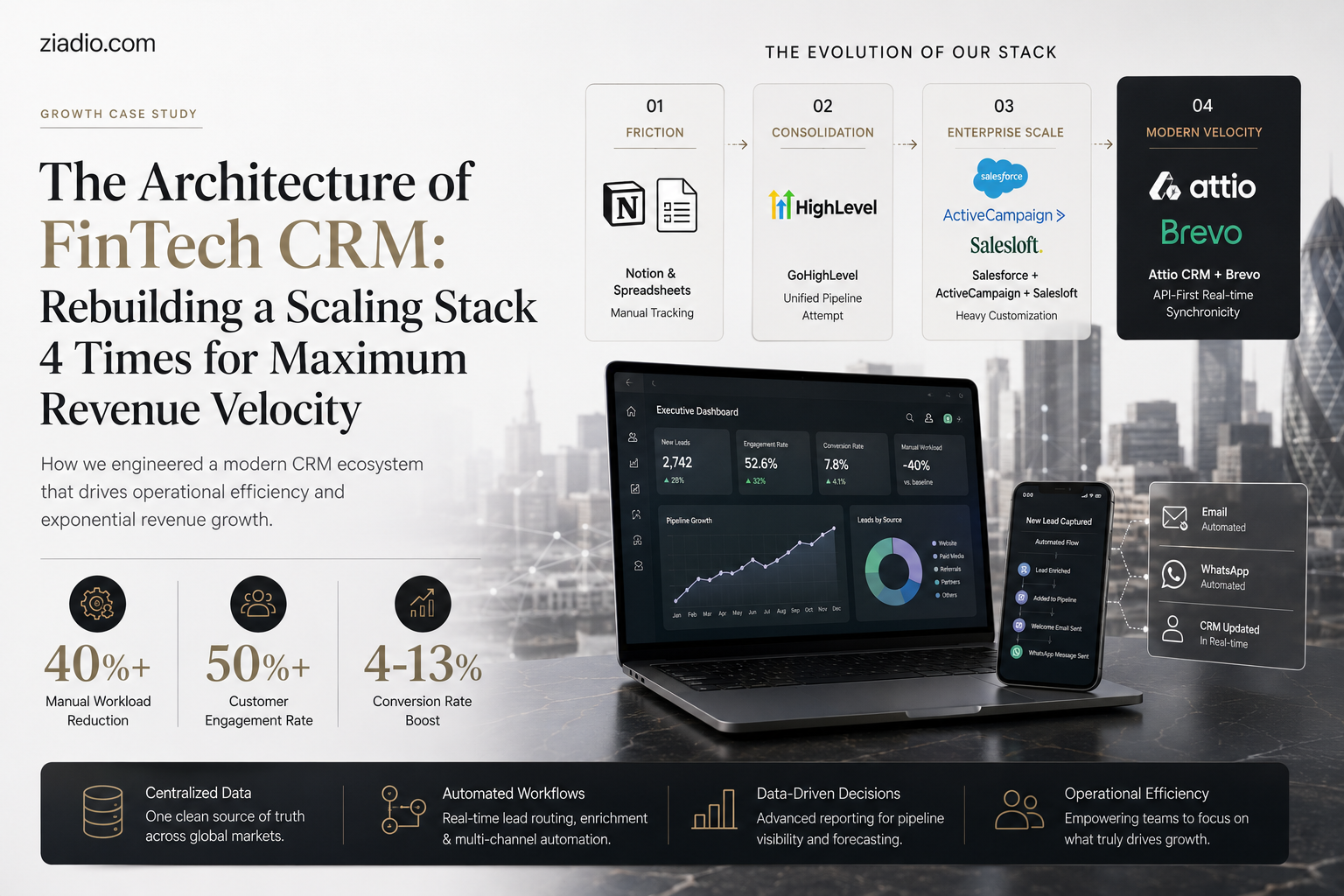
During my tenure as a Growth and CRM Specialist at a Fintech Startup, operating in Cairo, Egypt, and London, UK, I spearheaded the multi-stage digital transformation of our entire go-to-market (GTM) data stack. Over three years of intensive cross-border scaling, I architected and executed migrations across four separate CRM and marketing automation layers. This continuous evolution successfully centralized fragmented customer profiles, slashed the sales team’s manual tracking workload by more than 40%, and rocketed customer engagement rates from low single digits to over 50%.
The Evolution of the Stack: 4 Crucial Horizons
As a startup expands, its CRM requirements change dramatically. What works at the pre-seed stage becomes a operational bottleneck at Series A. Here is the exact architectural blueprint of how we scaled our systems across 4 distinct phases:
[Phase 1: Friction] Notion & Spreadsheets (Manual Tracking) │ ▼ [Phase 2: Consolidation] GoHighLevel (Unified Pipeline Attempt) │ ▼ [Phase 3: Enterprise Scale] Salesforce + ActiveCampaign + Salesloft (Heavy Customization) │ ▼ [Phase 4: Modern Product-Led Velocity] Attio CRM + Brevo (API-First Real-time Synchronicity)
Phase 1: The Manual Baseline (Notion & Spreadsheets)
- The Setup: In the earliest days, inbound leads, partner accounts, and outbound records were logged across multiple Notion databases and shared Google Sheets.
- The Bottleneck: Completely static data. There was zero automated correlation between user behavior and sales notifications, resulting in slower response times and high manual data entry overhead.
Phase 2: The Consolidated All-in-One Experiment (GoHighLevel)
- The Setup: Migrated legacy lists into GoHighLevel to run unified SMS, email pipelines, and basic pipeline visualizers.
- The Bottleneck: While it fixed the initial isolation of tools, it lacked the granular enterprise flexibility required to deeply customize complex, multi-tiered pipeline structures for cross-functional B2B teams.
Phase 3: The Enterprise Powerhouse (Salesforce + ActiveCampaigns + Salesloft)
- The Setup: As we entered heavier scaling cycles in both the Middle East and European markets, we deployed an enterprise-grade ecosystem: Salesforce as our central Single Source of Truth (SSOT), ActiveCampaigns for marketing automation, and Salesloft to power outbound sequences.
- The Advantage: Unparalleled reporting and structured validation rules.
- The Friction: Extremely high system maintenance, slower deployment speeds for growth experiments, and complex user adoption requirements for agile sales development representatives (SDRs).
Phase 4: Modern Product-Led Agility (Attio + Brevo)
- The Setup: To optimize for modern data-driven velocity, we migrated our architecture to an agile, API-first stack: Attio CRM mapped directly to our product analytics, coupled with Brevo for programmatic marketing automation flows.
- The Outcome: This setup provided instant custom object mapping, ultra-fast pipeline modifications, and effortless webhook integrations to track product adoption signals in real time.
Operational Engineering: Eliminating Funnel Leaks
Setting up a CRM is only half the battle; building automated journeys that drive conversions is where the actual growth happens. We engineered two core workflows:
1. Automated Lead Qualification and Instant Nurturing
We integrated website submissions, inbound landing pages, and lead capture networks via automated webhook routers. The moment a prospective merchant submitted their details:
- The lead profile was programmatically enriched and routed into a specific tier pipeline inside the CRM.
- A synchronized webhook instantly triggered a highly conversational multi-tiered welcome flow combining high-deliverability email and WhatsApp templates.
- Impact: This approach completely eliminated manual routing delays, boosting overall web conversion rates from near zero up to a highly profitable double-digit range (4-13%).
2. Advanced Multi-Channel Outbound Personalization
Using data captured from our tracking infrastructure, we built hyper-targeted messaging segments. Instead of broad blasts, leads received dynamically personalized email sequences and automated instant WhatsApp follow-ups based on their specific industry vertical, region, and engagement level. This advanced personalization successfully skyrocketed customer engagement metrics from single digits to over 50%.
Key Data Insights & Results
- Centralization: Successfully consolidated disparate data silos across international regions (Saudi Arabia, UK, Cyprus, India) into a single, clean infrastructure.
- Operational Efficiency: Reduced the sales team’s manual workload by 40%+, allowing them to spend less time filling spreadsheets and more time closing active accounts.
- Engagement Boost: Lifted overall lifecycle response and engagement metrics from historical single digits to a sustained 50%+ benchmark.